Transcript
Search it, or tap a time to listen from there.
And Mary said, I have seen the Lord. Amen? Father in heaven, because of the gift of Jesus and his on the cross and his rising from the grave, the human mouth is able to sing, I have seen the Lord. We're not worthy, O Lord, but you've had mercy upon our sin and you've opened our eyes.
Open our eyes yet again this Easter morning. And we pray this in Jesus' name. Amen. You all may be seated. Oh my word, Resurrection. I mean, is it possible that you've outdone yourselves yet again this Holy Week? It was Palm Sunday, 1954, when the Bishop of Chicago drove out from the city, found parking on a back street in West Chicago, Illinois, walked into an American Legion Hall there on the main street in West Chicago, where a church was being planted 69 years ago. Palm Sunday. I've always been thankful for two things. One is, I'm very thankful the Bishop did not name us Church of the Palm Sunday. I mean, that would kind of fit you guys, a little quirky, a little offbeat, beautiful. Yeah. I'm also thankful that he chose on Palm Sunday to name you Church of the Resurrection.
And I'm not sure that Episcopal Bishop of Chicago in 1954 knew what he was unleashing on the Western suburbs when he gave us that name. But your name matters. Today is first and foremost the feast of the resurrection of Jesus from the dead. But it's also your name feast. Resurrection.
And it's your birthright. So you will know deaths, engel gothas, and long holy Saturdays. And if you're faithful as you have been, you will know mornings like this. How do you get to belief in the resurrection of Jesus from the dead? How did Mary Magdalene get from the angel's words,
come, he is risen, come see where he lay, pointing to a grave cloth on a stone slab. How did she get from there to grabbing the feet of Jesus? Can you not help but remember that those feet are still punctured with those nails from just three days prior and worshipping him? How do you get, how do you transverse that spiritual territory? From the grave cloths to the glory of the worship of Jesus, the Son of God and the Savior. This morning I want to just take us quickly through four facts that we need to make that journey to transverse that territory. And then I want to take us through four forces that from the very beginning, from the very day of the resurrection, four forces that were arrayed against the four facts that are working against even today, us believing in the resurrection of Jesus from the dead. And then take us finally to a decision that every human being at some
point has got to face. And you, being told the story this morning, are now given a responsibility and given a challenge. That in the hearing of the resurrection of Jesus from the dead, you too must decide the four facts. How will I respond to the four forces? What will I do?
There are many facts of evidential reality that support the resurrection of Jesus from the dead. They're actually, when you line them up, quite staggering. I'm going to move through these four facts rather quickly to spend more time on the four forces. But first and foremost, the most undisputed fact of the historic reality of Jesus is it is universally accepted across historians of all backgrounds and particular convictions that Jesus of Nazareth lived and that he was executed in a Roman form of penalty on a cross.
Undisputed. Well, the next fact is not fully undisputed. It is strongly accepted among scholars of various persuasions that there was an empty tomb. First, the very fact that those who would record this historical event and would want others to believe in this historical event, they were up front about their agenda. And we were up front about our agenda. We want you to believe that Jesus Christ rose from the dead. And they were up front about that agenda and they wrote those Gospels that others may believe. And in doing so, they made a glaring strategic mistake. It's a tragic reality that it was a mistake. But in the ancient Near East, to have women be the ones who encountered Jesus first would have soiled the story at that time. In the ancient Near East, and tragically so, women were never trusted as witnesses in a court of law. They were viewed as completely unreliable. Why would they be witnesses to the empty tomb unless it was empty?
And those who wrote the story were compelled to tell the truth. One Jewish scholar, not a believer in Yeshua, calls the fact of the empty tomb, quote, a disconcerting fact. An honest scholar. Third fact, the apostles' willingness to preach the resurrection, the family of God, hear it amid this glory, hear this amid the beauty of those flowers.
Those apostles not only preached the resurrection, they died one by one because they believed in the resurrection and they were persecuted for such. Eleven of the twelve original apostles died because of their faith in the resurrected Jesus. Indeed, the disciples experienced the resurrected Jesus many times, over and over again. Do you know that there is no reliable history whatsoever to say that one of the apostles later came back and said, it's a hoax. I can't take the pressure. We did take the body. We did hide the body. These are men who before the resurrection broke one after another, either betrayal, either lying, either denial, or just running in a kind of passivity. Not one of them came back and said, this never happened. Every one of them, eleven of the twelve, died because they believed it. Now it's one thing, an adherence of other belief systems will have such adherence to that belief system that's been handed down to them that they might even consider dying for that.
We know that's the case. Christianity isn't the only faith that has martyrs. But these martyrs were not receiving a handed down set of beliefs while they were receiving and living in the fullness of their Jewish faith. But they were first hand witnesses of the resurrection. They knew whether it happened or not.
Fourth fact. Perhaps, honestly, the most compelling fact. If we can get that slide, Josiah. Here's a Caravaggio rendering of the conversion of the Apostle Paul. One of the strongest facts that point to the historical reality of the resurrection of Jesus Christ from the dead is the conversion of Paul. Paul was a well educated, extremely strategic, very respected, highly energized, profoundly activated, extremely gifted genius of a scholar and a leader. And he turned all of the wealth of his gifting and experience against the resurrected Jesus and his followers. He was the hostile enemy. One of the stars in the chief priest's galaxy. He had everything to lose, literally everything to lose. Financial well-being, psychological well-being, and his very life were he to believe that Yeshua was raised from the dead. It would be like Richard Dawkins, well-known Oxford University atheist, who suddenly comes out on Twitter that he's had a conversion encounter with Jesus. Except Dr.
Dawkins would just be joining two millennia and billions upon billions of people who already got there before him. How smart is that? But not Paul. No, he's joining a handful of women, Galilean fishermen, some prostitutes, tax collectors. And join them, he did. And lead them, he did. Because on the road to Damascus where he was going to persecute more followers of Jesus, that man met the resurrected Jesus. And he's come back. He's absolutely prone.
See, when you meet Jesus, resurrected from the dead, that's what you look like. Right there. He's blinded at that time. Okay, great, thanks. We'll pull that up later. Okay, so it'd be easy to think, okay, okay, hold on. If you're here and you're a skeptic, or if you're here and you have people that you love dearly, that you pray for, that you carry in your heart that are skeptics, it's easy to think, okay, if I could just have that kind of encounter, or if my skeptical dad, or my skeptical roommate or spouse could just have that kind of encounter with the risen Lord, oh my word, I would believe. They would believe. The facts are great, but where is the strength to the facts? Dr. Gary Habermas is a Christian scholar who spent many of his years as a youth, as a skeptic. He writes now on the theology of the resurrection, and tells a story in his skeptic days, was
in his house, and he's looking out a window, like we can right now, and he said, God, if you're real, take that tree down. Didn't happen. Shrugged his shoulders, yeah, yes, I was right. That night, there was a cataclysmic storm in their neighborhood. Tornado blew
through. One tree in the entire neighborhood went down. That tree. And Gary Habermas remained a skeptic for five more years. Facts are important, but facts are not enough. And there are actually forces, primeval, early forces, that generated on the day of the resurrection, that are arrayed against you and against me, and against the entire world, believing the resurrection of Jesus from the dead. The section right after the account of Mary meeting Jesus and grabbing His feet, tells us another story of the other ones who also had a first-hand experience in the empty tomb. It was not just the Marys that were there, but it was the guards. And Matthew tells us the reality of the guards. You show just a slide now of this scripture section from Matthew 28. They indeed went from there, while they were on their way, some of the guards went into the city and reported to the chief priest everything that
had happened. The stone, the angel, the angel sitting on the stone, the angel speaking. Probably didn't mention they were so scared it's like they were dead. Probably didn't mention that part. The words, He is not here, He is risen, come see where He lay. It told the chief priest everything. And when the chief priest had met with the elders and devised a plan, they gave the soldiers a large sum of money, telling them, you are to say, His
will be done. They took the money. They took the money. And they went out and they lied. And this story has been widely circulated among the Jews to this very day. The first force we see in verse 12 is the utter profound force of money. In Jesus' teaching, He would teach that money is not simply transactional currency, but that money has an immense spiritual power. He had a name for this power. He called it mammon. And indeed, the chief priest, in their exercise of power, would use sums of money not once, but twice to get done what they had to get done. Because they didn't have the power of God. They chose the power of the money God. And it's a great power, the power of the money God.
Judas, for 30 pieces. The guards, for a large sum. Now while none of us are getting paid to deny the resurrection of Jesus from the dead, money, the power, the spiritual power of money, is still a force that's arrayed against us, living in the power of the resurrection of Jesus. Because money promises you another life. Money promises you a life that can feel like a resurrected life. A life with energy. A life with assurance. A life with confidence.
People work very hard. People cut legal corners. People compromise their personal ethics to get money so they can feel like they're having a life, a robust, secure life. Money and the resurrection of Jesus promise the same thing, a life. And moreover, money creates the powerful deception that they can solve the most intractable problems. If we just have money, we can get Judas to betray Him and we'll know where Jesus is. If we just have money, we can tell these guards, go out and tell a lie. We'll pay you for it. See the guards have an intractable problem. What's happened on their watch, at worst will lead to execution. At best will lead to other shame and dismissal and a life of ill repute. They will lose their jobs, their livelihood, their position and reputation. They are desperate for money.
And the chief priests are desperate to undermine the rabbi Jesus because they just got an eyewitness account of the resurrection of Jesus. Just a quick moment. Look how Jesus loves them. They're acting adversarially and they were adversaries. But that's not how Jesus thinks. He thinks about souls.
He thinks that anyone can come to the power of the resurrection. The very men who did everything they could to bring Him to false accusation, false trial, utter execution, utter shame, they're now some of the first to hear about His resurrection because that's what Jesus is like. And that's the power of the resurrection is it reaches every single person and gives every single person, yes, the chief priests, an opportunity to decide. Some of the first to hear alongside the apostles are the very men who plotted His demise and destruction. There's a reason why there's a phrase, follow the money, which is used when you're trying to ascertain a crime.
So often the power of money is used. The force of lying, verse 13. The power of lies is utterly immense. They told a lie and that lie is still believed today. That the body was stolen. That's how powerful that lie has survived two millennia. It is still being perpetuated.
Lies are powerful for at least two reasons. First, they're powerful because words are powerful. And lies hijack the glory and the beauty of what words are meant to be and what words are supposed to be. The glory and the beauty of the very vehicle that says, I have seen the Lord. The glory and the beauty of the very vehicle that bears witness to the resurrection, even to the chief priest, they get hijacked by the father of lies, the devil himself. And lies have immense
power. Alexander Solzhenitsyn, a leader in the Soviet Union, intellectual leader pushing against the totalitarian regime of the Soviet Union in 1974, the night before he was exiled to the United States after having served in gruesome jail and concentration camp circumstances, wrote an essay that every follower of Jesus should read. It's called Live Not By Lies. And what Solzhenitsyn says in that essay is this, quote, our way must be, colon, never knowingly support lies.
Not just don't speak a lie, never knowingly support lies. One of the great forces, a raid against the power of the resurrection is the power to compel us to go along with a lie. If we believe the resurrection and the truth that Jesus rose from the dead, then we need to be able to discern a lie, we need to name a lie, and we need to refuse to live by a lie. Amen?
That's part of your birthright. That's part of what you're given as men and women of the resurrection. Family, God, there are lies that we cannot support as followers of Jesus. It is a lie that's been perpetuated by our judiciary in 2015 and now our legislature and our president in December 2022 that people of the same sex can be married. That's not true.
That's a lie. The vast majority of Christians believe it's not a lie. But the witness of the scriptures is that God made man male and female in his image. And it's very important on this resurrection morning that we are clear in a kind of confidence and gentleness and kindness. I don't believe that lie. That's not a marriage. It's a lie that a person who is following Jesus cannot be changed by Jesus. It's a lie that sharing our faith with others doesn't matter because hell is just some kind of vague, gauzy, probably unreality anyway.
It's a lie that the body was stolen. It's a truth that Jesus rose from the dead. Third force, a very powerful force, which is the force of social power. Look at that. If the poor gets to the governor, we will satisfy him and keep you out of trouble. How many dreams are had of a march to the principal's office? Because we're all terrified of getting in trouble. And we would love somebody that when we are in possible trouble can come to us and say, hey, I've got enough social power. I can get you out of trouble. Oh, what a relief. What do I have to do? Why?
Take this money. Again, the guards had very good reason to want the help of the chief priests. They were facing likely execution for dereliction of guard duty, a very serious offense. So the chief priests exercised their social power to, quote, keep them out of trouble. Social power now has to do with social platform. And with the social power and social platform, those of us that engage in that world are very aware that one must abide by the rules of social platform. And one must refuse to transgress the boundaries of social power and social platform.
If we like what influencers are putting forward, we can stay out of trouble. If we get into trouble, we can only hope that some influencer, some of the social platform will, quote, keep us out of trouble. Do we live by that power or the power of the resurrection? Final fourth force. Here's it.
And it's probably the most heartbreaking. To give the guards a little bit of credit, they're being tempted by money. They're being tempted to lie. They're being tempted to have social power used on their behalf. All this is coming outside of them to them.
But now we have agency. Now we have the core of the human person, which is now going to be activated. What will they do with the money and the call to lie? What will they do with the social power that's being arrayed for them or against them? How will they respond? How will they engage the dignity of the human person, which is the dignity to choose, which is the dignity to live not by a lie. It's the dignity to live not by money. It's the dignity to live not by social power. It's the dignity of living as Jesus lived and dying as Jesus died. That's your dignity.
That's your agency. And the guards, in a tragic moment, I'm making babies cry. That's horrible. I've got to settle down. I'm sorry. They choose the force of self-preservation. It's heartbreaking because don't you recognize it? I do. I recognize that. Self-preservation, self-containment, self-strategy, I totally recognize that.
Eschew my dignity? Sure, sure, sure. What do I have to do to get out of trouble? What do I have to do to make this problem go away? It's a great force, the force of self-preservation. And there's only one other force that can counteract it. And it's the force of self-surrender. It's the force of believing that Jesus rose from the dead and that he has a power that he has now gained from the gift of the Father and trampling down death and taking our sins upon him on the cross. It's that force that he can now give you. He can give you the resurrection power that rose him from the dead. So that what? You can apply the force of money or social power? No, no, no. So that you can die to self. So that you can self-surrender. Look at that slide again of Paul as we conclude.
It's that. That's what it looks like to believe the four facts. That's what it looks like to renounce the four forces. That's how we get to the feet, the pierced feet of Jesus and worship him. He's not here. He is risen. I have seen the Lord. In the name of the Father and the Son and the Holy Spirit. Amen.
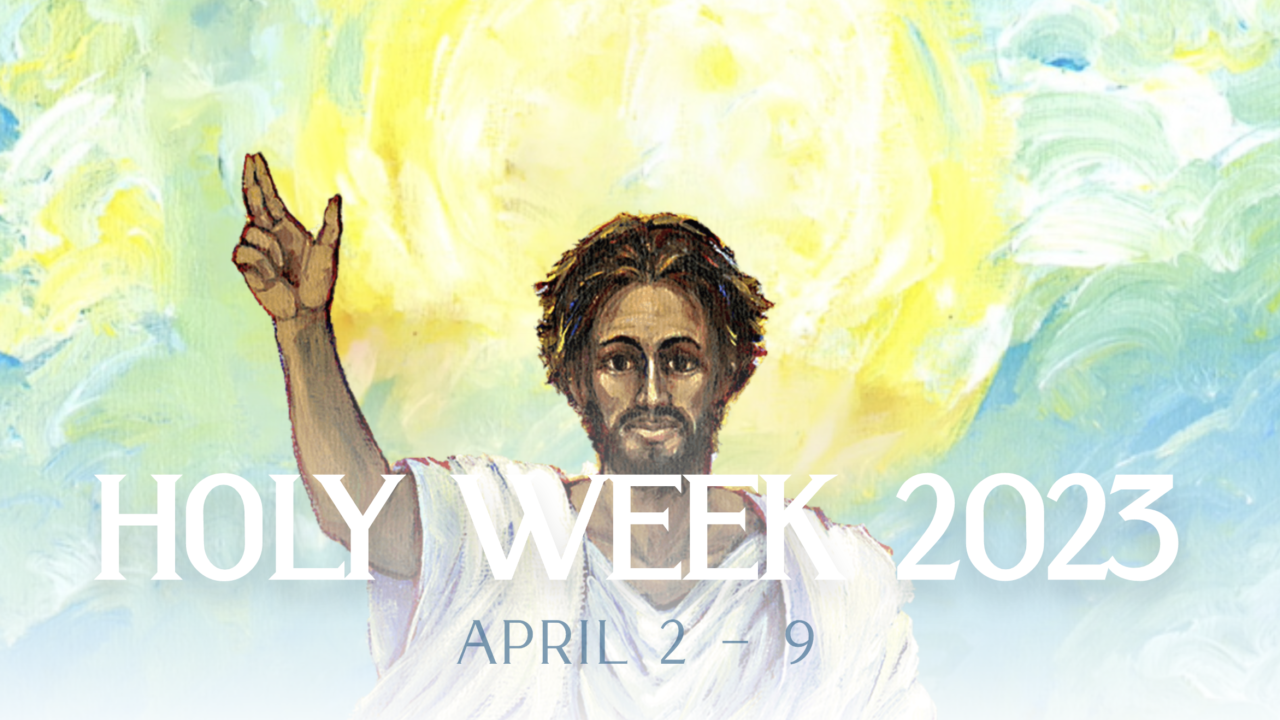
Holy Week 2023
10 sermons
- Entering the Great Story
Texts: Matthew 21:1-11, Philippians 2:5-11, Matthew 27:1-54
- A New Commandment
Texts: Exodus 12:1-14, Psalm 78:15-26, 1 Corinthians 11:23-32, John 13:1-15
- Come to the Cross
Texts: Isaiah 52:13-53:12, Psalm 69:1-16, 34-36, John 19:1-37
- Wounded for Our Transgressions
Texts: Isaiah 52:13-53:12, Psalm 69:1-16, 34-36, Hebrews 10:1-25, John 19:1-37
- Easter Vigil, "The Story of Creation"
Texts: Genesis 1:1–2:2, Psalm 33:1-11
- Easter Vigil, "The Flood"
Texts: Genesis 7:1-5,11-18;8:8-18;9:8-13, Psalm 46
- Easter Vigil, "God's Presence in a Renewed Israel"
Texts: Isaiah 4:2-6, Psalm 122
- Easter Vigil, "Jonah and the Fish"
Texts: Jonah 1:1-2:10, Psalm 130
- Easter HomilyNow viewing
Texts: Acts 10:34–43, Colossians 3:14, Psalm 118:14-17, 22-24, John 20:1—18
- God's Final Word
Texts: Acts 10:34–43, Psalm 118:14-17, 22-24, Luke 24:1–12