Transcript
Search it, or tap a time to listen from there.
So a true story, there's a biography on Abraham Lincoln by a man named John Meacham, who's a historian. He tells a story about towards the end of the Civil War, Abraham Lincoln was visiting one of the battlefronts where there was going to be a battle the next morning. And so they're getting ready for this battle, they're talking military strategy, and then Abraham Lincoln looks down and he sees three little kittens, little puffs of gray, and he picks them up and tenderly cuddles them in his arms and he says, according to an eyewitness, he said, poor little creatures, don't cry, you'll be taken good care of. And then he orders a colonel to get some milk for the kittens. And this is a really tender scene. One of the eyewitnesses later said, it was a curious sight upon the eve of a great military crisis to see the hand that signed the Emancipation Proclamation tenderly caressing three stray
kittens. So I read that story and it really moved me, and I had to ask, why does this get to me so much? And it's not because I'm fond of cats, and I'm sorry, I know there's cat people out there, but I've met two cats I really liked, and they both acted like dogs, you know, so cats are great if they can act like dogs, but anyway, so I thought, why was it? You know, and it's just, I think it was this. We have, especially in our culture today, in our climate, the landscape of this country and around the globe, a leader who can balance power and authority with such tenderness and gentleness, that just seems like such a rare thing, and today, it seems like an almost of an unheard of thing. We don't expect that from people in power. We don't expect that from people with authority to notice and see and then treat with such
kindness and use their strength to lift up creatures that are weak and vulnerable and So, in our gospel reading, and actually in our Philippians reading as well, we're going to see the person of Jesus, these two poles, this power and this tenderness, this strength and yet gentleness, blended together utterly brilliantly and beautifully and boldly like no human being displays, and as Christians, we believe that this wasn't just a human being, but it's God in human flesh. God coming down to us, showing what God's character is like, what the triune God is like in his essential nature, is to be strong and powerful and yet gentle and tender at the same time. So, we're going to look at two themes in Jesus from both scripture readings, from the first reading, the first Gospel of Mark reading you heard, and then also from the Philippians reading, that there's nobody higher than Jesus, and also that there's nobody lower than Jesus.
Nobody's gone lower than Jesus. So, if you're a follow along in the Bible kind of person, and I encourage that, but if you want to follow along, so the two readings, the first, the Gospel reading of Mark is found on page 847, and there's Bibles underneath your seats, and then the Philippians reading is on page 980, and we're going to see in this passage that Jesus is the one and only servant king, the king of kings who came to serve, and he is the final leader, the one, the ultimate authority to whom we owe our very lives and to whom we say, you alone are worthy to be the Lord of my life, my leader, my ultimate influence, my ultimate sovereign, the one that I surrender to. So, let's look at that first thing. There's no one higher than Jesus, and if you turn to the Philippians reading, we'll flip back and forth. So at the end of that reading, which is probably like an ancient Christian hymn, it says that
therefore God has highly exalted him, Jesus, and bestowed on him the name that is above every name, and then there's going to be three everys. Jesus is above every name, verse 9, verse 10, every knee should bow in heaven and on earth, and verse 11, every tongue will confess that Jesus is Lord. It's really an astounding statement, and it's exactly what we see going on in a more subtle way, but it's exactly what's happening in the gospel reading of Mark, that first palm Sunday. Jesus is acting as the ultimate authority that is above every name, that is above every president, that is above every leader, that is above every ruler, that is above every authority. He is the final ultimate authority. He said, all authority has been given to me. So in all four gospels, Matthew, Mark, Luke, and John, you'll find the palm Sunday story, and then all of them will refer back to this verse in the Old Testament that's really important,
Zechariah chapter 9, which we'll get to in just a minute. But the first thing I want you to notice about this whole event is that Jesus is in charge of this whole thing. He's the master of ceremonies, of pretty much his own party celebrating his kingship. So as somebody has said, Jesus is incredibly humble, but he's not modest. So this whole thing is going to be about him, and he plans the whole thing. So he knows when this is going to happen. He knows where this is going to happen. He knows what animal to get. He knows who to get it from. He knows what to say when they say, hey, hey, hey, hey, you can't just be taking that donkey, man. Nobody's ridden on that donkey before. You can't be taking that. And Jesus goes, well, I know that's going to happen, so you tell them this. You tell them, the Lord has need of it.
Oh, OK. Yeah, that's fine. Like, the Lord. So what does the Lord mean? So that's a really important word to nail down. So the Lord in the Greek is Kyrios, which could mean Sir or Master or just Big Shot or Big Cheese, or it could mean Lord God Almighty. So five times in the Gospel of Mark, here's how you interpret the Bible contextually. You look at the context. What is what is the meaning? Is Jesus talking about himself as a divine prerogative, like he has the authority of God or is he just saying, I'm a big cheese? Well, in the context, Mark chapter 10 and 11, the word Kyrios is used five times and it refers every time to God. So Jesus is most likely in this passage. It seems overwhelmingly obvious he's referring to, he's taking upon himself God's authority. And look what he's doing. He's planning a parade. He's basically planning like you've been, I don't know if you've been to a small town,
small town parade. They're just they're kind of haphazard and people just kind of jump in and people throw things and it's like, so he's planning this whole thing. It's crazy. Kids are singing. People are throwing palm branches. They're taking off their coats. They're throwing them on the ground. And look who's in the center of it all.
Jesus planning it and putting himself at the center. I said he's humble, but he's not modest. Jesus is never. Oh, shocks. Just a little old me, Jesus. I don't want to offend you. If you've got a few minutes, I don't want to trouble you too much. Don't want to make your life inconvenient, but I just have a couple of suggestions for your life. Okay. He never does that. He always comes as Lord. That's why the earliest Christian creed was three words. Jesus is Lord. It was a bold, you say that in the Roman empire. That is a bold, counter-cultural, anti-authoritarian statement that no, Caesar's not my Lord. Jesus is my Lord. That was a huge statement.
So there's nobody higher than Jesus. Now let's look at the second statement. There's also nobody lower than Jesus. So back to Philippians. So reflecting back on the life of Jesus, verses seven and eight, There's no one that's gone lower. You can't get any lower than a crucifixion. And not only a crucifixion, but a crucifixion between two common criminals. How incredibly shameful was that? To be associated with common criminals. Here's Jesus. He lived his whole life as this good and holy man, sinless.
And the last stage of his life, he's condemned between two criminals. All four gospels allude back to Zechariah nine. And let me just read that verse for you. You don't have to turn there, but let me just read it to you. So Mark doesn't quote it, but he's alluding to it like the other three gospel writers. So Zechariah nine, chapter nine,
He's the king. Make no mistake about it. There's nobody higher than him. This is the Messianic king. This is the king promised in and through the Jewish people, who would come not only to rule the Jewish people, but would come to rule all the earth. You can read about it in Psalms like Psalm 2, Psalm 45, Psalm 72. If you want to look those up later. He's righteous and having salvation is he. But look at this, he's humble and mounted on a donkey, on a colt, the foal of a donkey. Now I don't know a lot about military strategy, but I do know enough to know that if you're like a military general, if you're a powerful, important person, you're not going to ride in on a donkey. I mean, they're slow. They can't pivot. You're vulnerable. You're a sitting duck. You look like a fool because servants rode donkeys. But in all four gospels, Jesus is riding on this donkey.
It's really important. You can compare this to some of the Roman rulers. So for instance, in 46 AD, Caesar rode into Rome as a triumphant conqueror. The man who had killed over a million people, so it was alleged, and fought 50 successful wars. He rode into the city on a chariot with three white horses with a laurel crown upon his head and an eagle scepter in his hand. And so he rode in and then the people started celebrating and they had theater and they had gladiator games where 500 men lined up against each other and killed each other, all to please Caesar for his power.
And then there was Jesus riding on a donkey, vulnerable. Peasants are impulsively taking their ratty coats off and throwing them on the ground. People are impulsively taking palm branches and waving them. I want us to see here, though, something really important because this isn't just Palm Sunday. This is the whole story of the Bible in a nutshell, is happening right here.
Jesus, no one higher, no one lower. So Tim Keller, pastor out in Manhattan, late pastor out in Manhattan, he liked to say, the essence of sin is servants, creatures, us, putting ourselves in the place of God. That's the essence of sin. The essence of the gospel, the good news of Jesus, is the living God putting himself in the place of a servant to save us. See that remarkable plot twist? So every time, every sin, whether it's the sin of racism, the sin of sexual immorality, the sin of greed, the sin of cruelty, the sin of violence, it doesn't matter what it is, it is us, creatures, servants, putting ourselves in the place of God. I'll do whatever I want. But the gospel is something radically different. The living God, the King of kings and Lord of lords, puts himself in the place of a servant.
Not only a servant, but willing to die on a cross. He goes low. How low? Lower than you could ever go. Believe me, you think, how low can I get? Let's see, how low can people get in sin and in sorrow and in shame and in mental health issues or physical health issues? How low can people get in getting off track spiritually? How low can people get in failure?
Jesus has gone lower. Not that he sinned, but he descended into our sin and bore it upon himself. Why did he do that? Well, our creed tells us in really shorthand for us and for our salvation. For you and your salvation, he came. That's why he descended. Why do you think Jesus came? Do you think he came to skim the top of the humanity pool, the cream of the crop, the best, the brightest, the most beautiful, the strongest, the most moral, the most righteous, the most Anglican, the most spiritual? Do you think he came to just come and skim off the top? No, he descended. He descended to hell. You can't get any lower than that. So what do we see at Palm Sunday? We see, behold your king. He's riding on a donkey. Behold your king. He's born in a stable. Behold your king. He's eating with sinners. Behold your king. He's washing feet.
Behold your king. He's dying on a cross between two criminals. He is, as St. Paul said later in the New Testament, the one who became sin so that we might become the righteousness of God. The one who knew no sin, who became sin so that we might have God's righteousness.
There's no sin. There's no darkness. There is no sorrow. There is no failure. There is no shame that you are going through right now that Jesus Christ cannot get underneath it and lift you up. C.S. Lewis once said that, actually he was talking about the incarnation, but this is really the whole life of Jesus. He said, it's like a pearl diver. You know, like those Polynesian pearl divers who strip basically naked and then they dive into the water and they go down and down and down past the warm, light water into the murky, dark, cold water where there's slime and ooze and death and decay. They go all the way down and they grab the pearl that they're looking for and then they come up and they break the surface gasping for air with the pearl in his hand, the prize that he went down for. And I would say, Lewis didn't say this, but I would say, the pearl is you.
He came for you. He came for us. He came for us and for our salvation. As we begin this Holy Week, let me give you an invitation. And it's, I really don't think it's, it's not from me. It's, this is bigger than me, behind me. This is like Jesus behind me and he's giving you this invitation.
And the invitation is simply this. As we begin this Holy Week, I really don't want you, the first thing to do is just, I'm gonna be better. I'm gonna be a better Christian. I'm gonna work harder. That's a good thing. It's not a bad thing. But I want you to take this first step and just say, Lord Jesus, I believe you are who you are. You died for my sins and I want you to be my Lord and Savior. I want to come under your living Lordship.
Now, this has been really helpful to me is to pray something like this. Because that seems like all or nothing. And because I know I'm such a, I'm such a divided person and I kind of like my sins sometimes and I want to hold on to it sometimes, but I can do this. I can say, and I think you can say, okay, all that I know about me, Lord, all my past, all my present, all of my future, all of my weaknesses, all of my struggles, all of my sins, even my resistance to you, even my hesitation, even my doubt, even my weak faith, I bring that all. I bring that all. And would you be the Lord of my life? I want to invite you to do that. Maybe today, maybe sometime this week. You know, I was talking to a young man this week, or a couple weeks ago, this Hindu background guy,
and we were talking about theology and we got involved in this discussion and the conversation kind of broke down and I just thought, I am just not getting through, I'm not explaining myself very well. He was asking questions about my faith, I was asking questions about his faith. He seemed very articulate, he seemed very clear, I seemed very fuzzy, I wasn't clear, and I just thought, I just wish I would've just like put my hands on his shoulder and just said, look, this is the gospel. We, we are both broken, sinful men. We have both failed to live up to God's standard. We have failed to follow his way. But he came for us. We don't ascend to him, he descended to us. In the person of Jesus, fully man, fully God. And he came to save us and to forgive us and to make us new. And he pursues us and saves us.
That's the gospel. And when I understand that, when I get that, when that sinks in, then it changes me so I want to say, Jesus, I want you to be the Lord of my life. If you are that good, if you are that loving, if you are that kind, if you are that holy, if you have that much power and strength, then I want to come unto you. I want to surrender everything to you.
I pray, and we pray that that will be your experience this holy week. In the name of the Father and the Son and the Holy Spirit. Amen.
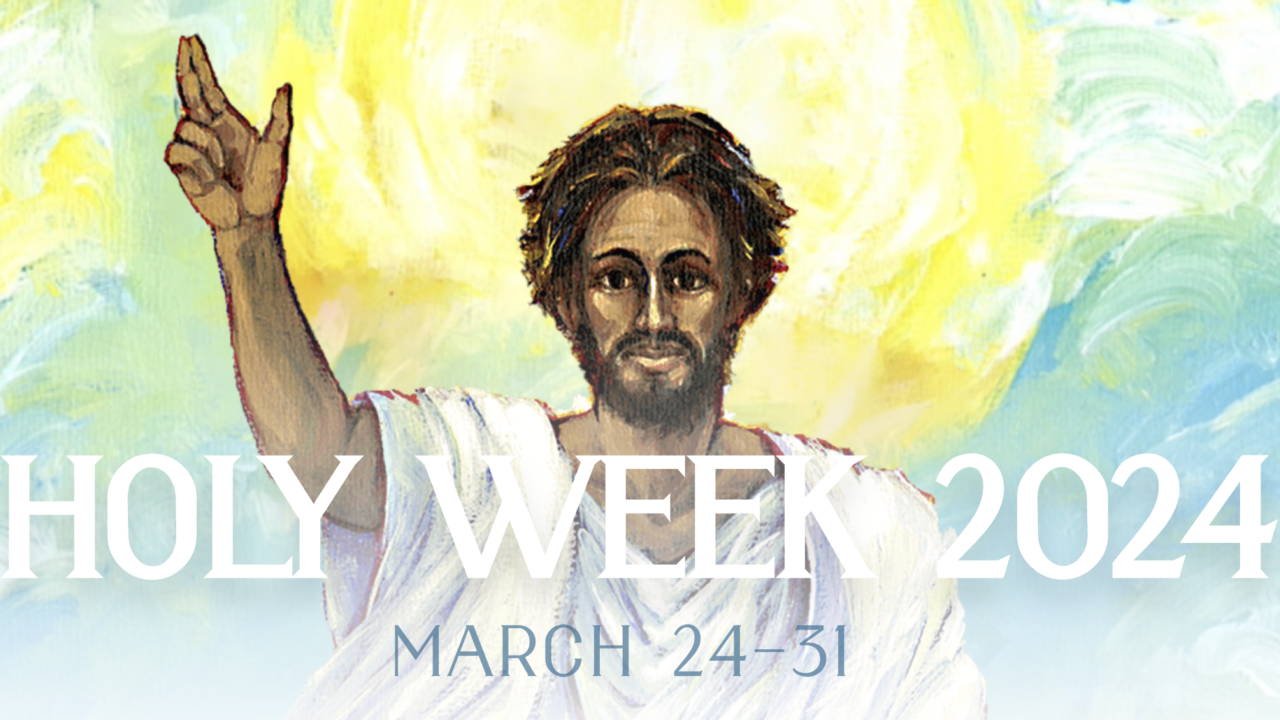
Holy Week 2024
11 sermons
- The Faithful Friend
Texts: Exodus 12:1-14, Psalm 78:14-25, John 13:1-15, John 15:12-15
- By His Stripes We Are Healed
Texts: Isaiah 52:13-53:12, John 19:1-37
- God Makes a Way
Exodus 14 · Exodus 2:23-25 · Exodus 3:7-8 · John 14:6
- Easter Vigil, "The Fall"
Ephesians 6
- Easter Vigil, "Abraham's Sacrifice of Isaac"
Genesis 22:1-19
- Easter Vigil, "God's Presence in a Renewed Israel"
Isaiah 4:2 · Isaiah 28 · Isaiah 52:14
- Easter Vigil, "The Three Young Men in the Furnace"
Hebrews 11:33-38 · Matthew 5:8
- Easter Vigil, "Jonah and the Fish"
Jonah · Luke 23 · 2 Corinthians 4
- The Everyday Power of the Resurrection
Texts: Romans 6:1-14, Matthew 28:1-10
- The Everyday Power of the Resurrection
Texts: Romans 6:1-14, Matthew 28:1-10