Transcript
Search it, or tap a time to listen from there.
Good morning. My name is Father Matt, one of the priests here at Church of the Resurrection. So last month, my brother-in-law sent me a book that I read a quote in the book that changed my life, which is a little funny because my brother-in-law is an atheist. And maybe if you don't know me, I'm not an atheist. So Bishop, you may be relieved to hear that. But we love atheists and agnostics and all kinds of people. So anyway, my brother-in-law and I, we disagree on a lot of things, religion, politics, ultimate destiny of human beings and how we came to be here and all kinds of stuff. But we do agree on one thing. We have a profound love for the great, late Southern writer Flannery O'Connor. So he sent me this book, which is a prayer journal written by Flannery O'Connor when she was a student at the Iowa Writers School, learning to be a writer.
And so she wrote these prayers out by hand. And one of them just like really struck me. So she says this in one of her prayer journal entries. We are dependent on God for our adoration of him. Adoration that is in the fullest sense of the term. And then she turns to prayer, which she so often does. Give me the grace, dear God, to adore you, for even this I cannot do for myself. So I just put the book down and I thought, wow. So here's what struck me about that. So Jesus said, like loving God is like the most basic thing. He called it the first and greatest commandment. That's like Christianity pre-101. And that's what our whole life is based on. But what Flannery O'Connor is going to say and what we're going to see here in the scripture as well is that I can't even do that most basic thing by myself.
I need the help of the triune God to love and adore the triune God. I can't do that by myself. That's the gospel. So as we're going to see in this passage, this passage is going to talk about how the with Jesus life is simply means that at all times, in all places, you are never throwing back on yourself to live the Christian life. Nothing you do in the Christian life. You are throwing back on your own limited and twisted in on yourself. And I know that about you because I know that about myself so well. You're never throwing back just on yourself. In everything, at all times, in all places, in everything that you do and with all the people that you're with. It is the with Jesus life. Now a lot of times the gospel is presented like this. Jesus has done a lot for you. I mean he did so much for you.
Right? Because of that you should live for him. Which is true. That is a true statement. But there's something even underneath that, all around that, more fundamental than that. And that is the with Jesus life. So even when you're doing life for Jesus, you're first and foremost doing it with him. I want to invite you to turn to that scripture reading from Romans chapter 6. And I don't know what page it's on because I have a little blank in my notes where I'm supposed to write down the page, but I didn't do that. So look it up. You'll find it. It's in the New Testament. It's after the book of Acts.
And I want you to look at my sermon prep. So there's my sermon prep. Now maybe you wonder like, wow, how do they write sermons at res? Well, it's a three-step process. You read the Bible passage that you're going to preach on. You circle stuff. And then you stand up and you talk about what you circled. Okay, so it takes about seven minutes.
Okay, so they pay us. They pay us to do this. Like, oh, Father Matt's not available for the next few days. He's working on his sermons. Okay, so he's circling stuff. Okay. But they pay me good money to know what to circle. Okay. You people don't know what to circle. That's why we.
That's why you need us. So. So notice. But back to the text. Okay. So notice what I circled. All the with hymns. So verse four, we were buried, therefore, with him. Verse five, we've been united with him. At the end of verse five, we've been united with him. Verse six, our old self was crucified with him. Verse eight, we have died with Christ. We shall also live with Christ. And then there's a few in Christ as well, you know. But let's just focus on the with for now. That's enough for one sermon. Okay. So, again, the Christian life is not fundamentally living for Jesus. Although that is true. It is most fundamentally living with Jesus. So let's look at this passage. Let's start with the two bookends of this, this, this kind of literary unit. Chapter six verses one through fourteen.
So verse one, Paul starts with a imaginary objection to the argument he's been making so far in the book of Romans. And he says, what shall we say then? Are we to continue in sin that grace may abound? And then I just want you to notice the end of this, this kind of unit. In verse fourteen, for sin will have no dominion over you since you are not under the law, but under grace. So you notice in both of those verses the word grace. So the Christian life is a grace receiving life. So five times in chapter five, Paul talks about the free gift. He uses that free gift, free gift, free gift, free gift, free gift. Five times. So the Christian life is receiving a free gift that the Lord Jesus offers us. So Paul has this imaginary objector going, OK, great. So it's free. It's grace. Now I can live any way I want.
Right. And Paul goes, no, that is really, really dumb. You're not getting it at all. That's like somebody who spends their like 30 years in prison. They get pardoned and they're like, you know, I think I'll just stay in prison the rest of my life. Paul says, no, that just does not make anything. That doesn't make any sense at all. And what he's going to talk about, look at your baptism, conversion. God made something happen. He took what happened in the past with what Jesus did. He took what's going to happen in the future, who we're going to become in Jesus. And he took the present and he just like mushed them all together. And it was just in baptism. We just celebrate one big wow, Jesus moment with Jesus moment. And you get dunked in Jesus. You get wet with Jesus. And look at verses three and four. So do you not know that all of us who've been baptized into Christ, Christ Jesus were baptized into his death.
We were buried, therefore, with him by baptism into death. We'll get to the rest of that verse later. So the Christian life is not primarily like. Try harder. Work smarter. Be a better Christian. Be a better version of yourself. Because your old self is not good enough. So you need to be better.
Look what Paul says in verse six. So first, the with Jesus life. First thing is, with Jesus life breaks the power of sin. And then it unites us with his resurrection. So look at verse six, first of all. We know that our old self was crucified with him in order that the body of sin might be brought to nothing so that we would no longer be enslaved to sin.
I always find it like. I don't know. I just don't understand this when I guess maybe I do this sometimes, too, where people say, you know, I'm I'm I'm my own person. I make my own decisions. I'm my own man. You say, you know, I'm my own woman. I'm like, I I'm in charge of my life. I know what I'm going to do. I'm I'm perfectly rational, choosing, willing human being. And St. Paul in the scripture says, no, no, you're not actually. You're more enslaved than you would ever dare to admit. You know, we're all like it's like a little kid playing with a remote control car. You know, we do have a free will. So we do have that aspect of ourselves. But there's a lot of our life where it's like a little kid controlling a remote control car.
You're the car, though. OK, go left. Go right. And what are you being pulled around by? By our old sin nature. So we lost greed. Think that thought bitterness. We're under control of our old self. And Paul says, when you were united with Jesus, that was broken.
The guy running the remote control car, the remote, the remote was smashed. Now, we still live that way. So we have the rest of our life to realize. Wait a minute. I'm not under that anymore. I'm with Jesus. I'm not with the guy with the remote control car anymore. I'm with Jesus. It is a slow, sometimes agonizing slow process of living into our newness in Jesus, our freedom in Jesus. And that's why we need each other to help in that process. That's an embodied communal thing. We don't just do that by ourselves. We do that together in and through the church.
And notice what else happened. So not only does this with Jesus life break the power of sin, but it also unites us to his resurrection. So look at the end of verse 4. And it says, in order that, and that's what, that's a purpose clause, for this purpose. In order that, just as Christ was raised from the dead by the glory of the Father, we too might walk in newness of life. So think of what happened to Jesus. He was dead, 100% dead. There was nothing about him that wasn't dead. Every cell in his body was dead. His internal organs were dead. His brain was dead. There were no waves, no brain waves. God the Father touched him, said a word, be risen. And brought him to glorious new life. Not just resuscitated him, but resurrected him. Incredible.
But, here's something else that goes with that. In with your Jesus, in with your with Jesus life, God also wants that to happen to you. You share in that. In order that, we too might walk in the same newness of life. About a thousand years ago, there was a guy named Simeon. They called him the new theologian. Maybe Stephen can tell me someday who was the old theologian. I don't know, but he was the new one. And he said this. He said, the resurrection of Jesus takes place in each of us who believe. And that not once, but every hour so to speak. When Christ the Master arises in us. I love that. Christ wants to touch you with his resurrection power. Not just once, but every hour of your day. That's a good summary of Romans chapter 6. Now look at verse 11. So it says, so, here's the kind of the conclusion. Boom.
And then we're going to get to the application. Because I don't have to apply it, because the text itself offers an application. So here's the conclusion to this. So, you also must consider yourselves dead to sin and alive to God in Christ Jesus.
This is true. So, one of my heroes is a guy, a British guy named John Stott, who passed away. I don't know, maybe eight, ten years ago. A lot of people he mentored around the world called him Uncle John. He even preached once in my church out in Long Island. That was before I got there. But still, it was pretty cool that he preached there. So, he said this, summarizing verse 11. He said, if Christ's death was a death to sin, which it was, he says, and if his resurrection was a resurrection to God, which it was, and if by faith, baptism, he calls it, we have been united in his death and resurrection, which we have been, then we ourselves have died to sin and risen to God. Paul says, think about this. Don't let this just fly by.
This is not just an Easter Sunday thing. This is your life. Let this sink into you every single day. This is what we're learning to live into. But notice what happens next. It's not just a thinking thing. This is where I got in trouble for like 25 years in my Christian life because I heard all these sermons on Romans 6 and I'm going, okay, think, think, think, think, think. It's like Winnie the Pooh. Think, think, think, think, think, you know. But it's like, I just, it's just not getting into my life, you know. Well, that's because you're not just supposed to just think about it. You're also supposed to do something else to experience the power of the resurrection. Look at verse 13. This is where it gets really, really down into our ordinary everyday life. Do not present your members to sin as instruments for unrighteousness, but present yourselves to God as those who have been brought from death to life
and your members to God as instruments for righteousness. So this is really important. Let me just break this down word by word. So what are the members? What's that talking about? Presenting the members of your body. Well, members of your body is like your fingers, your hands, your ears, your mouth, your head, your arms to hug people, your legs to go places, your mouth to speak, your hands to make food or to change a diaper or to shake hands with a friend. Those are the members of your body. Literally, they're just the parts of your body. And then your physical abilities, your mental abilities. What does he say not to do? He says, well, first, don't take the members of your body and present it to sin, like, hi, sin, here we go. I'm showing up. I'm showing up to you, sin. Sin is like a power. It's like a real power. It's almost like a person, you know, but it's not a person, but it's like a power.
And don't present yourselves to sin. Well, what are we supposed to do? Well, notice, as those who have been brought from death to life, you were dead, like Jesus was dead. You were spiritually dead. God made you alive. So as those kind of people show up every day to God and say, okay, God, I present. Here I am, present and accounted for. I am present to you and I offer to you the members of my body as instruments of righteousness.
What's an instrument? Well, it could be, in the original language, it might have been like a weapon of war or it could have been, it could have just been like an implement, like a shovel, like a sewing needle, like to repair things or a shovel to dig things or a scalpel to cut and do surgery or a hammer to pound things or a wrench to turn things. You have the power in Jesus to repair, to cut, to heal, to dig, to plant, to fight, to nurture.
See how practical this is? So this is a little spiritual discipline I've been doing for, I don't know, the last 15 years since I moved here to Chicago. So I don't do it every day, but I try to do it at least three, four times a week. I have a little prayer journal. Sometimes I don't write a lot. Sometimes I just write these lines at the top. Abba, Father, because God is my Father in and through Jesus. And then I say, Here I am, Lord Jesus. I'm showing up. Here I am. I'm presenting myself to you. What are we going to do together today, Lord? What are we going to do? Who are we going to talk together today, Lord? What work are we going to do together today, Lord? What meal are we going to make together? What conversations are we going to have with people? Because you're going with me. And I'm with you.
And I'm in you. You see how practical this is? Where do you see the power of the resurrection? In your ordinary, embodied existence. Just in your body. What you do with your body. How you present it to God. It's so practical. It's so everyday. Not only you think it, but you do it. Now, I just want to offer something this morning. Just a little prayer. And we've been kind of sprinkling little prayers for you to join us in as we preach sometimes this weekend. So here's a little prayer that just starts something like this. Lord Jesus, here I am. Here I am.
I wasn't just messed up. I was dead. But you made me alive. Let me live this day for you. What are we going to do together today, Lord? Simple prayer, something like that to start every day. It's the with Jesus life. Always, everywhere, with all people, in all your activities, with Jesus. So when you feel tempted, you're with Jesus. You can call on him. When you're lonely, when you're aching for intimacy, it's a with Jesus life. When you feel like, my faith is just not very good. My faith is inferior. It's just sub what it should be. And I feel ashamed. You're in a with Jesus life.
When you're on mission, you go, I want to do something good. I want to help people. I want to change the world. I want to love my kids. I want to love my neighbors. You're never doing it alone. You're with Jesus. When you're at work, you're with Jesus. When you've sinned and failed, when you have regrets,
you come back and say, sorry, Lord, I wandered. I forgot. But I'm with Jesus now. Here's the thing that I love about the Bible. When it says that as Christ was raised from the dead by the glory of the Father, we too might walk in newness of life. A word like that is always now. It's always now. It's never just then. Or it's never just when. It's never then when it was written. It's never when you can get your life together enough. No, you can have it now if you call out to the Lord right now. Fresh every day. His mercies are new every morning. The power of the resurrection is new every morning. Today is the day of salvation, the Bible tells us. Now is the day. Every day Jesus offers this to you. Receive the free gift that he offers you. Let Jesus touch you. And that's exactly what we do when we go to the baptismal font.
And we're asking Jesus to touch a couple people in a special way, but it's all of us. And the baptismal waters will be sprinkled on you, and then you'll come to the Eucharistic table. And that is all about entering into the with Jesus life.
May you walk in newness of life to the glory of God the Father. In the name of the Father, and the Son, and the Holy Spirit. Amen.
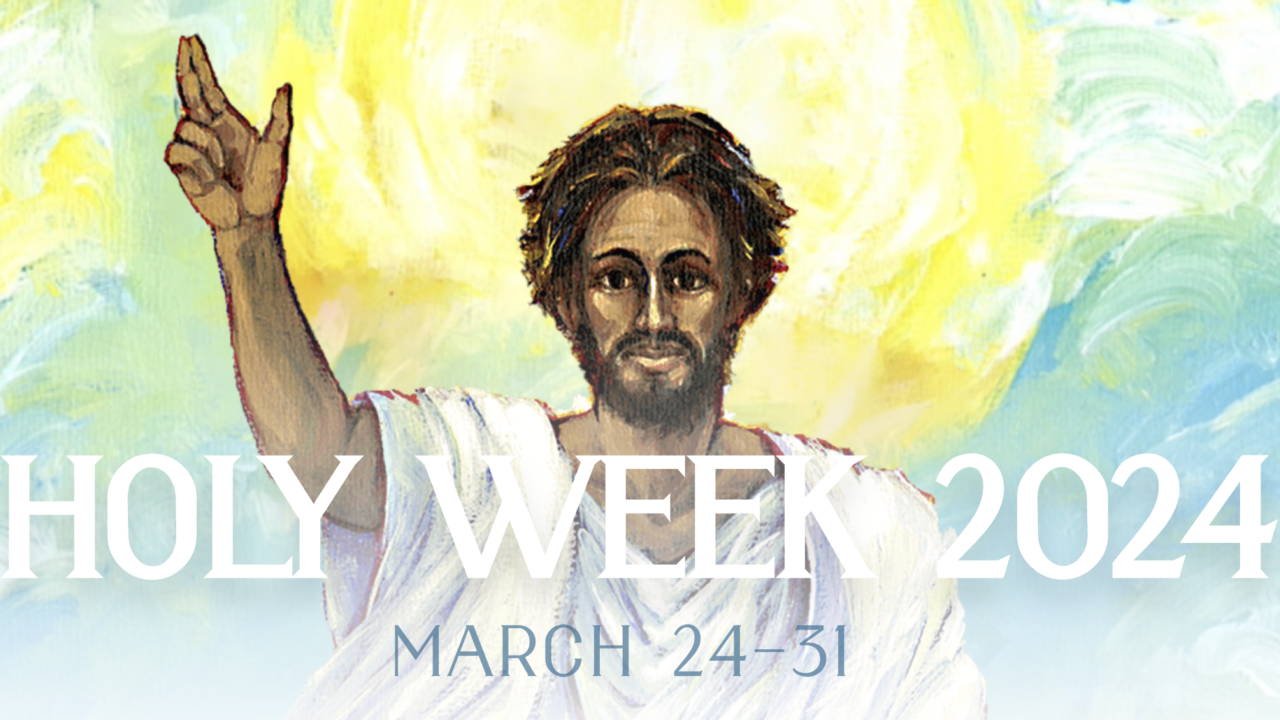
Holy Week 2024
11 sermons
- And Then There's Jesus...
Texts: Mark 11:1-11, Philippians 2:5-11, Mark 15:1-39
- The Faithful Friend
Texts: Exodus 12:1-14, Psalm 78:14-25, John 13:1-15, John 15:12-15
- By His Stripes We Are Healed
Texts: Isaiah 52:13-53:12, John 19:1-37
- God Makes a Way
Exodus 14 · Exodus 2:23-25 · Exodus 3:7-8 · John 14:6
- Easter Vigil, "The Fall"
Ephesians 6
- Easter Vigil, "Abraham's Sacrifice of Isaac"
Genesis 22:1-19
- Easter Vigil, "God's Presence in a Renewed Israel"
Isaiah 4:2 · Isaiah 28 · Isaiah 52:14
- Easter Vigil, "The Three Young Men in the Furnace"
Hebrews 11:33-38 · Matthew 5:8
- Easter Vigil, "Jonah and the Fish"
Jonah · Luke 23 · 2 Corinthians 4
- The Everyday Power of the Resurrection
Texts: Romans 6:1-14, Matthew 28:1-10