Transcript
Search it, or tap a time to listen from there.
All right. When I decided to focus on the book of Isaiah in my doctoral studies, I didn't realize I was signing up to preach at 2 a.m. from Isaiah. Father Matt told me last Sunday, he said, that's what you get for being the Isaiah guy. So here we go. This passage, which you can find on page 569, divides into three parts. In verse 2, we see a vision of God's glorious land. Verses 3 and 4, a vision of God having a purified people. And verses 5 and 6, a protective presence from the Lord. Tonight, we're only going to focus on verse 2, so if I continue to be the Isaiah guy, maybe we'll get to the next few parts over the next few years. I want you to imagine a devastated land. What comes to mind for
you? For me, I think of being in Mississippi ten months after Hurricane Katrina. And for a week, I drive along a coastal highway. And out one window, I would see a green, brown, frothy ocean that's clearly polluted. Out the other window, I would see an uninhabitable
land. Trees have been uprooted and twisted. Mounds of dirt unevenly strewn across the horizon. No sign of green. Debris everywhere. It's like being in a war zone in that devastated land. The question I ask tonight that we ask is, does God care about devastated lands?
What does Holy Week have to tell us? Well, the backdrop to our passage in Isaiah 4 is a hurricane that we could call Assyria and then later Babylon that comes and absolutely devastates the land of Israel and Judah. And what Isaiah the prophet dares to declare is that God is the one behind and within the storm of Assyria, bringing judgment against his people, bringing judgment against the land. So devastation was God's decree against his rebellious, sinful people in the land. But thanks be to God, devastation is not God's final word for his people, for his land. Isaiah 4 verse 2 holds forth this beautiful window of hope that our God is a God who transforms devastated land into glory. In other words, the same God who brings devastating judgment will also resurrect a humbled land to glory.
Listen to this verse. In that day, the branch of the Lord shall be beautiful and glorious and the fruit of the land shall be the pride and honor of the survivors of Israel. Let's go bit by bit through that verse begins within that day and within Isaiah in the first few chapters in that day occurs six times in that day and that day and that day and that day and that day. That day has been a day of judgment, a day of devastation, a day of destruction. We read that the haughty looks of people will be brought low and the lofty pride of humanity will be humbled because the Lord alone will be exalted in that day. But in Isaiah 4 verse 2, what we find is that this future day is more than a day of judgment. On the other side is a day of salvation. It goes on in that day, the branch of the Lord shall be beautiful and glorious.
The fruit of the land shall be the pride and honor of the survivors of Israel. What's meant by the branch of the Lord? In Jeremiah, the branch of the Lord is a reference to the Messiah. But when you look at our verse, what you see is a parallel between the branch of the Lord and the fruit of the land. And with this idea of fruit of the land, the sense seems to be that God is talking about the land of Israel itself. You see, in the wake of warfare, walled cities would have been torn down. They would have been burnt with fire. Crops would have been eaten, trampled, burnt by invading armies. Trees would have been chopped down. You know, God had promised his people a land flowing with milk and honey. He promised them a taste of what Adam and Eve had when they were in the garden. But God's judgment against them has led them not to have that land flowing with milk and honey,
but a land more like a wilderness. But Isaiah 4 verse 2 looks beyond. He looks beyond and speaks of the branch of the Lord. And this idea of the branch of the Lord is connected with this idea of sprouting the Lord himself. The branch of the Lord will burst forth with new life and vegetation sprouting forth out of the devastation will be the branch of the Lord.
And just as the spies, do you remember when they come into the land of Canaan? What do they bring back? They bring back the fruit of the land. And here, when it speaks of the fruit of the land becoming the pride and honor, God is saying, I'm going to recover what this land should be. A beautiful land bearing fruits and sprouting forth with life. Look at how it's described. It's going to be beautiful and glorious. The fruit of the land is going to be the pride and honor of the survivors of Israel. Now, within Isaiah, to use these descriptors, beautiful and glorious or proud and honor. These are shocking descriptions because throughout Isaiah, God is set against
the beauty and the pride and the glory that is seen throughout the world. Ephraim had these beautiful vineyards, this glorious landscape. They were proud. And in Isaiah 28, God says he's going to strip them bare. Judah with his booming, glorious hills, this booming economy or even Babylon described as beautiful and glorious, proud and honorable
are going to be brought low. Why? Because anything that smacks of human pride and glory needs to be eradicated because God alone will be exalted. But the very God who strips glory and honor and beauty that is simply derived from humanity and for human glory is the one who promises a land that is beautiful and glorious, a land that will make its people proud and full of honor. But this land that bears such fruits will not fuel the self-seeking interests of humanity, but will instead point to the God who transforms devastation into glory.
Now, when we think about this vision of a transformed land, it may be hard for us to connect with at 2 a.m. or for those of you who live in dorm rooms and don't feel connected to land. But if we look deeper into our hearts, I think we see
we're made to be in a flourishing place like Adam and Eve. That longing resides deeply in our hearts. For me, my favorite place at our home is our backyard. Over the summer, we got a new dog named Kobe, and by the fall, Kobe had learned something. He likes to dig holes.
My beautiful backyard became full of holes, and so this whole winter, I've been thinking, how can I fix that? I came up with a great idea about two weeks ago. I'd go to my front yard, and I'd dig a flower bed around our front tree, and I'd transport that turf from the front to the backyard and fill all those holes. And I did that, worked very hard, was really proud. When Katie came home, I said, look what I've done. But within 24 hours, Kobe had dug up all my turf, and now my yard looks worse than before, because now there are hundreds of pieces of turf just scattered here and there.
Now, other than sympathy, I do have a reason for sharing this. It just points to our desire to be in a place of beauty that flourishes. But let's turn to our world today. Let's turn to our Lord's body. When we look at the land of Israel,
in my years, I'm 44, some of you are much older, some much younger. If we look at the land of Israel that's supposed to go from the Euphrates to Egypt, includes the West Bank and Gaza, we see a land where the sprout of the Lord, the fruit of the land,
seems to be a long way off. When we look across the world, we see barren, fruitless landscapes. In the Congo, 26 million, Afghanistan, 20 million, Yemen, 17 million, Syria, 12 million, South Sudan, 7.7 million. All of these together, 83 million people facing starvation because the land isn't producing.
But what does this show us? Does our God even care about devastated land? What does Holy Week tell us? Well, when we look to the physical body of our Lord Jesus Christ, our Lord Jesus Christ had the body of Adam. Adam comes from the word Adamah, land.
Jesus's body shares the dust and dirt that we have. When we look to this physical body, that at the end of his life was dehydrated. At the end of his life was scourged with marks across his back. When we look at a body with thorns that have pierced his brow. When we look upon his nakedness, his nail pierced hands, the wound on his side.
We say with Isaiah 52, 14, his appearance was so marred, was beyond even looking like a human being. If ever there was here before us in the tomb was devastation in the flesh. Yet if our God can raise the devastated body of our dirty Lord Jesus from the dead, then we have hope that one day our God will transform a devastated land of Canaan, where the sprout of the Lord, the fruit of the land will become a source of beauty and glory and splendor and honor. And if the resurrected physical body of Jesus gives us hope that God will transform Israel, then we can have hope that our God one day will recreate this entire world into a fruitful paradise for believers. And there the faithful remnant will delight in the God who transforms devastation into glory. In that day, the branch of the Lord shall be and glorious and the fruit of the land shall be the pride and honor of the survivors of Israel.
In the name of the Father, the Son, and the Holy Spirit. Amen.
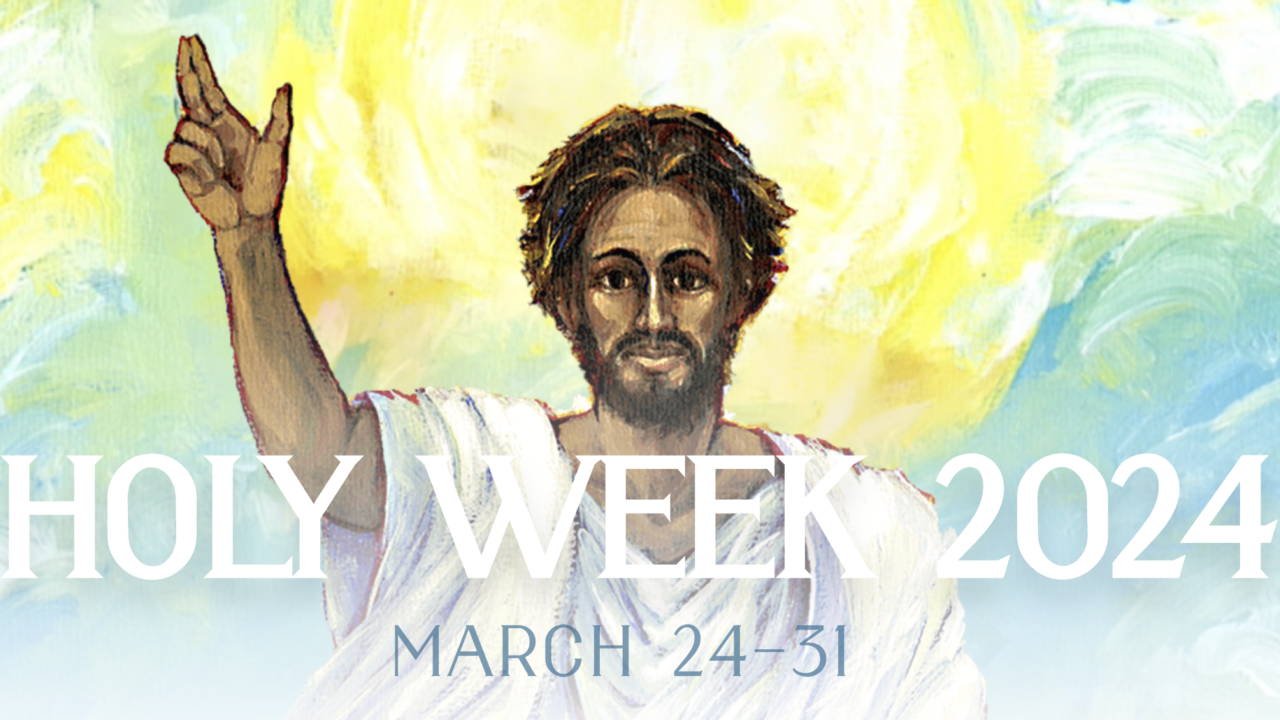
Holy Week 2024
11 sermons
- And Then There's Jesus...
Texts: Mark 11:1-11, Philippians 2:5-11, Mark 15:1-39
- The Faithful Friend
Texts: Exodus 12:1-14, Psalm 78:14-25, John 13:1-15, John 15:12-15
- By His Stripes We Are Healed
Texts: Isaiah 52:13-53:12, John 19:1-37
- God Makes a Way
Exodus 14 · Exodus 2:23-25 · Exodus 3:7-8 · John 14:6
- Easter Vigil, "The Fall"
Ephesians 6
- Easter Vigil, "Abraham's Sacrifice of Isaac"
Genesis 22:1-19
- Easter Vigil, "The Three Young Men in the Furnace"
Hebrews 11:33-38 · Matthew 5:8
- Easter Vigil, "Jonah and the Fish"
Jonah · Luke 23 · 2 Corinthians 4
- The Everyday Power of the Resurrection
Texts: Romans 6:1-14, Matthew 28:1-10
- The Everyday Power of the Resurrection
Texts: Romans 6:1-14, Matthew 28:1-10